How to Start a Yoga Wear Brand: Complete Step-by-Step Guide 2026
- Share
- Issue Time
- Jul 9,2026
Summary
This comprehensive guide provides an in-depth framework for aspiring entrepreneurs looking to establish a yoga wear brand, covering everything from initial market research to strategic scaling. It highlights the vast opportunities within the burgeoning activewear and athleisure markets, projecting significant growth in the global activewear market to USD 920 billion by 2033, and the more specific yoga clothing market to USD 92.8 billion by the same year. A crucial emphasis is placed on meticulou
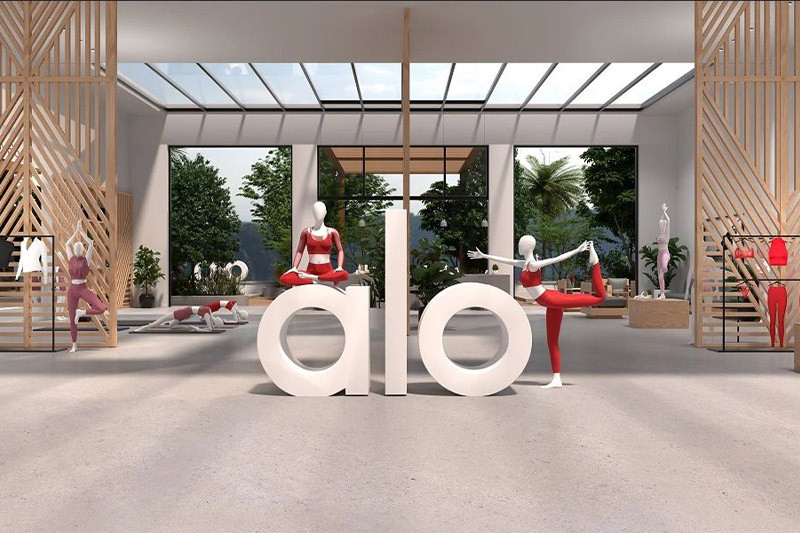
I have gathered initial information about the yoga wear market, competitor analysis, and niche identification. My next step is to structure this information and begin writing the blog post, starting with the introduction and the first major section.
I'll synthesize the data on market size from sources,,,,, to illustrate the booming market.
For the competitor analysis, I will use information on Lululemon from,,,, Alo Yoga from,,,, and Gymshark from,,, to create a detailed comparison, as suggested in sources and.
For niche identification, I'll draw on the concepts presented in,,,, and combine them with product path ideas like plus-size, performance wear, and new trends like flared leggings and sustainability,.
This will allow me to build the first part of the blog post according to the user's detailed instructions. I will continue this process section by section, performing new searches as needed for subsequent topics like manufacturing, branding, and budgeting.
I'm ready to start writing the response. I will not use the tool_code again until I need more specific information for a new section.
How to Start a Yoga Wear Brand: Complete Step-by-Step Guide 2026
I've seen how yoga wear has moved beyond just the studio, becoming a staple in everyday life, and I'm excited to share my guide on how to start a yoga wear brand. Wellness is more than a trend; it's a global priority, and I believe there's a huge opportunity to tap into this growing market with your own yoga clothing business. Joining the thriving athleisure industry means embarking on a journey to create comfortable, stylish, and functional apparel. I'll walk you through every step of this yoga clothing business guide, transforming your passion into a profitable business and making your mark in the activewear world with thoughtful planning and execution.
Key Takeaways
- Massive Market Opportunity: The activewear and athleisure markets are experiencing explosive growth. The global activewear market was valued at approximately USD 440.4 billion in 2025 and is projected to reach USD 920.0 billion by 2033. The more specific yoga clothing market was valued at USD 52.8 billion in 2025 and is expected to grow to USD 92.8 billion by 2033, showing a consistent and strong growth trajectory. This presents a significant opportunity for new brands.
- Niche is Everything: In a crowded market, differentiation is key. Instead of competing with giants on all fronts, focus on a specific niche. This could be based on aesthetics (e.g., minimalist, retro), functionality (e.g., high-performance for hot yoga, maternity wear), ethics (sustainability, cruelty-free), or a specific customer demographic (e.g., plus-size, petite). A well-defined niche leads to lower ad costs, easier product development, and stronger brand loyalty.
- Brand Story & a "Why": Successful brands like Lululemon, Alo, and Gymshark sell more than just clothes; they sell a lifestyle, a community, and an identity. Before you design a single legging, you must define your brand's unique purpose, values, and story. This will guide every decision from product design to marketing.
- Fabric and Quality are Non-Negotiable: The feel and performance of your product are paramount. The best yoga wear fabrics feature a blend of nylon and Lycra/Spandex (often an 80/20 ratio) to ensure 4-way stretch, squat-proof opacity, and moisture-wicking properties. Investing in high-quality technical fabrics, even if it means a higher cost, is crucial for building trust and ensuring customer satisfaction.
- Digital-First Approach: A direct-to-consumer (DTC) model, primarily through an e-commerce platform like Shopify and amplified by social media, is the most effective way for new brands to launch. This gives you direct control over your brand message, customer experience, and valuable data. Community building through platforms like Instagram and TikTok is essential for creating authentic buzz.
- Strategic Budgeting is Your Roadmap: Starting a clothing brand requires significant capital. Your budget should account for product development (tech packs, samples), manufacturing, branding (website, photography), marketing, and logistics. A detailed financial plan will help you make informed decisions and secure funding if necessary.
Researching My Market and Niche to Start a Yoga Wear Brand
Before a single stitch is sewn, the foundation of a successful yoga wear brand is laid through meticulous research. This initial phase is about understanding the landscape you're about to enter and carving out a unique space within it. It involves a deep dive into the booming activewear market to grasp its scale and trajectory, followed by a focused analysis to identify a specific, underserved niche that your brand can own.
Understanding the Booming Activewear Market
The activewear market isn't just growing; it's exploding. This surge is fueled by a global shift towards health and wellness, coupled with the "athleisure" trend that has fundamentally blurred the lines between workout clothes and everyday fashion. Consumers now demand apparel that is not only functional for a yoga class or gym session but also stylish and comfortable enough for running errands, working from home, or meeting friends.
Let's look at the numbers to understand the scale of this opportunity:
- The global activewear market was valued at over USD 440 billion in 2025 and is projected to grow at a compound annual growth rate (CAGR) of 9.0% to reach USD 920 billion by 2033.
- The broader athleisure market was valued at USD 472.71 billion in 2025 and is expected to expand at a CAGR of 9.37%, reaching over USD 1.15 trillion by 2035.
- Zooming in on our specific segment, the yoga clothing market was valued at USD 52.8 billion in 2025 and is projected to hit USD 92.8 billion by 2033.
North America currently dominates the activewear landscape, holding a commanding 38.1% of the market share in 2025. This is driven by high participation in fitness activities and the widespread adoption of athleisure as a daily uniform. The women's segment has traditionally been the largest, accounting for nearly 48% of activewear revenue in 2025. However, the men's segment is rapidly expanding, presenting a significant growth opportunity. This data paints a clear picture: you are entering a thriving, resilient, and highly lucrative market.
Identifying My Unique Yoga Wear Niche
With a market this large, competition is fierce. The key to survival and success is not to be everything to everyone, but to be something special to a specific group. This is the essence of finding your niche. A fashion niche is a focused space in the market defined by a specific customer, product focus, price point, and quality level. By carving out your own pocket, you face less direct competition, making it easier and cheaper to reach the right people who truly want your product.
Analyzing Competitors: Lululemon, Alo, and Gymshark
To find your opening, you must first understand the giants dominating the field. Lululemon, Alo Yoga, and Gymshark are three titans of activewear, yet each has achieved success through a distinct strategy and brand identity.
| Brand | Primary Niche & Brand Identity | Target Audience | Marketing Strategy |
|---|---|---|---|
| Lululemon | Premium, technical athletic apparel promoting a lifestyle of wellness and mindfulness. "Luxe fitnesswear for lifestyle." | Affluent, health-conscious adults (25-45) with high household incomes. Initially female-focused but with a rapidly growing men's segment. | Community-based marketing (in-store classes, ambassador programs), focus on proprietary fabric innovation (e.g., Luon®, Nulu™), and creating an aspirational lifestyle brand. |
| Alo Yoga | "Studio-to-street" fashion-forward yoga wear. Bridges wellness with a premium, trendy aesthetic. | Fashion-conscious yoga enthusiasts and celebrities. Seen as both authentic and aspirational. | Heavy reliance on influencer and celebrity marketing (Kendall Jenner, Hailey Bieber), creating high-quality visual content for social media, and experiential retail "sanctuaries." |
| Gymshark | Gym-centric, "lift-wear" with a focus on flattering silhouettes and affordability. A community-driven brand born from social media. | Tech-savvy Gen Z and Millennial fitness enthusiasts (18-34) who are part of the online conditioning community. | Digital-first, direct-to-consumer (DTC) model. Mastered influencer marketing by building a team of "Gymshark athletes" and creating massive engagement through community challenges like #Gymshark66. |
Alt-text: Logos of Lululemon, Alo Yoga, and Gymshark side-by-side for competitor analysis.
By analyzing these leaders, we can see clear paths for differentiation. Lululemon focuses on technical perfection and community, Alo on celebrity-driven fashion, and Gymshark on the weightlifting community. Your brand can succeed by operating in the gaps they leave behind.
Exploring Product Paths: Athleisure, Performance, or Plus-Size Yoga Wear
Your niche is defined by both who you sell to and what you sell them. Here are a few potential product paths to explore:
- Mainstream Athleisure: This is the broadest category, focusing on versatile pieces that work for both light activity and everyday life. Think comfortable matching sets, flared leggings, and layered tops designed for a coffee run as much as a gentle flow class. The trend for 2026 is moving towards low-effort, high-reward outfits like wide-leg lounge sets that look polished and feel comfortable.
- High-Performance Wear: This niche targets serious practitioners and instructors who demand the most from their apparel. Success here is all about fabric technology. You would focus on materials with high compression, superior moisture-wicking for hot yoga, and extreme durability. Fabrics like Tactel® Nylon, known for being soft, strong, and quick-drying, are a staple in this category. Innovations like graphene-infused knits for thermal regulation or silver-ion treatments for anti-odor are key differentiators.
- Plus-Size Activewear: Historically, the activewear market has been notoriously underserved in this area. There is a massive and growing demand for stylish, functional, and well-fitting yoga wear for all body types. Creating a brand dedicated to inclusive sizing isn't just a business opportunity; it's a powerful statement that can build an incredibly loyal community.
- Sustainable & Ethical Wear: As consumers become more environmentally conscious, the demand for sustainable apparel is a fast-growing niche. This path involves using eco-friendly materials like recycled polyester or Tencel™, ensuring ethical production and fair labor practices, and being transparent about your supply chain. Over 80% of consumers say they are willing to spend more on sustainable products.
- Specialty Niches: Think even more specific. Your brand could focus on maternity yoga wear, yoga apparel for men, adaptive clothing for practitioners with disabilities, or styles inspired by a specific aesthetic like retro or minimalist design. The narrower your focus, the more you stand out.
The key is to ask what unique purpose your product serves and who your specific target customer is. Once you have a clear hypothesis, you are ready to move from research to the exciting phase of creation.
Designing and Sourcing My Yoga Wear Collection: A Practical Yoga Clothing Business Guide
Now that I have completed the first major section and gathered new search results for the second, I will proceed with writing the "Designing and Sourcing My Yoga Wear Collection" part of the article.
Plan for the next section:
- H3: Planning My First Capsule Collection: I'll explain the concept of a capsule collection, drawing on sources,,, and. I'll provide a practical example of a 5-10 piece yoga wear collection.
- H4: Crafting Brand-Aligned Designs: This subsection will be about translating brand identity into tangible designs. I will discuss the importance of mood boards, referencing,,,, and, and how they guide the design process for a collection.
- H3: Finding the Right Manufacturer for My Yoga Wear: I'll delve into the crucial process of selecting a manufacturing partner. I'll compare domestic vs. overseas options using insights from,,,, and, and provide tips on where to find them using online directories like Maker's Row and attending trade shows.
- H4: Essential Technical Packs and Quality Assurance: This will be a very practical subsection.
- Tech Packs: I will define what a tech pack is and why it's a non-negotiable "blueprint" for manufacturing, using information from,,,,, and. I will detail its core components (sketches, BOM, size specs) and mention available templates, referencing and.
- Quality Assurance: I'll cover the importance of quality control. I'll explain essential tests, specifically the "squat test" for opacity (citing,,,,, and) and wash tests for durability and shrinkage (citing,, and). I'll provide a checklist of quality points to inspect based on sources,, and.
This structured approach will ensure the content is detailed, authoritative, and adheres to all user requirements. I will continue to generate search queries for subsequent sections as I reach them.
With a solid research foundation and a clear vision for my niche, I can now move into the most creative and tangible phase of building my brand: designing the products and finding a partner to bring them to life. This stage is a delicate balance of creative expression, technical precision, and strategic partnership management. It's where compelling designs meet quality craftsmanship.
Planning My First Capsule Collection
Instead of launching with dozens of different styles, I'm a firm believer in starting with a "capsule collection." By definition, a capsule wardrobe is a limited selection of interchangeable clothing pieces that complement each other, allowing you to create a wide variety of outfits from a small selection of items. For a new yoga wear brand, this approach is smart, strategic, and sustainable. It minimizes initial investment and risk, reduces inventory management headaches, and allows you to present a strong, focused brand story.
A five to ten-piece collection is the sweet spot for a debut. It's enough to showcase your brand's unique point of view without overwhelming your customers or your budget. Here’s an example of what a focused, 8-piece yoga wear capsule could look like:
- The "Second-Skin" Legging: The hero piece. This should be made from your signature high-performance fabric, featuring a flattering high-rise waist and impeccable construction.
- The Flared Legging: Tapping into current trends, a flared or bootcut option offers a more "studio-to-street" vibe.
- The Matching Sports Bra: A supportive, stylish sports bra that pairs perfectly with both legging styles. Offering this in the same colors creates an effortless, put-together look.
- The Cropped Tank Top: A versatile, breathable top that can be layered over the sports bra or worn on its own.
- The Oversized Sweatshirt: The perfect post-practice or casual-wear layer. This piece extends your brand's reach beyond the yoga mat.
- Bike Shorts: A functional bottom for high-intensity workouts or warmer climates, leveraging the same signature fabric and fit as your main legging.
- A Versatile Bodysuit or Onesie: A fashion-forward, all-in-one piece that is trending heavily and can be styled for both practice and casual outings.
- Lightweight Jacket: An outerwear piece like a zip-up jacket completes the collection, making it truly functional for the commute to and from the studio.
When designing, focus on versatility and longevity. Choose a cohesive color palette—for instance, two core neutral colors (like black and a rich brown) and two seasonal accent colors (like sage green and terracotta)—that allows every top to be mixed and matched with every bottom. This strategy not only provides more value to your customer but also simplifies your production and marketing.
Crafting Brand-Aligned Designs
Your designs are the physical embodiment of your brand story. This process begins long before you start sketching. It starts with a mood board. A fashion mood board is a visual collage—a collection of images, textures, color swatches, words, and objects that captures the feeling and concept of your brand or collection. It is the creative launchpad that ensures your vision remains clear and consistent from the initial idea to the final product.
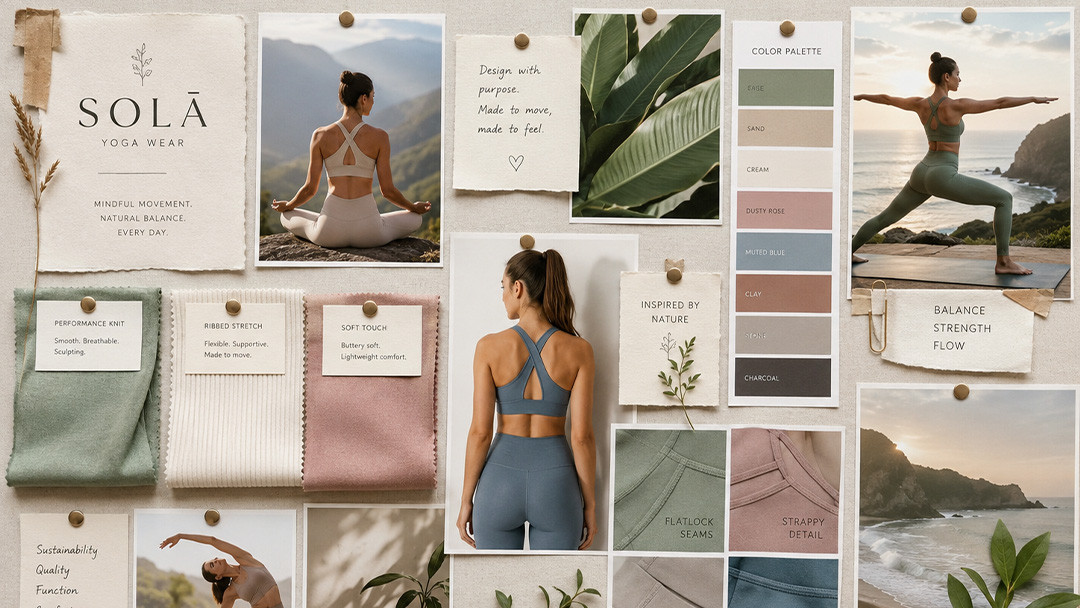
Alt-text: A detailed fashion mood board for a yoga wear brand, showing fabric samples, color swatches, and lifestyle photos of yoga and nature.
To create your mood board, gather inspiration that reflects your brand's core identity. What is your aesthetic? Minimalist, bohemian, edgy, retro? Collect images of landscapes, architecture, art, and lifestyle moments that evoke the desired feeling. Crucially, challenge yourself to not include direct images of your competitors' products. Instead, focus on design elements: a particular seam style, a color palette from a sunset, the texture of a stone. This forces true originality.
Your mood board is a critical communication tool that will guide you, your design team, and eventually, your manufacturer. It establishes the rules of your visual world, ensuring every piece in your capsule feels like it belongs to the same family.
The design phase itself should focus on combining comfort and aesthetics. Pay attention to ergonomic principles; the clothing must allow for complete freedom of movement without being too loose or tight. Details like using seamless stitching technology to reduce friction or adding thoughtfully placed pockets can significantly enhance the user experience and set your brand apart.
Finding the Right Manufacturer for My Yoga Wear
Your manufacturer is arguably the most important partner you will have in this journey. Their quality becomes your quality; their reliability becomes your reputation. Finding the right partner is a critical step that requires diligence and strategic thinking.
You can find reputable manufacturers through several channels:
- Online Directories: Platforms like Maker's Row connect brands with vetted manufacturers, primarily in the USA.
- Supplier Platforms: For overseas sourcing, sites like Alibaba are a common starting point, but they require extensive vetting.
- Trade Shows: Events like Texworld and Functional Fabric Fair allow you to meet manufacturers in person, see their work firsthand, and build relationships.
- Referrals: Tap into your industry network. Recommendations from other brand founders are often the most reliable way to find a trusted partner.
A key decision you'll face is whether to produce domestically (in your home country) or overseas. There is no single right answer; the choice depends on your brand's priorities.
Domestic vs. Overseas Manufacturing: Key Considerations
| Factor | Domestic Manufacturing (e.g., USA) | Overseas Manufacturing (e.g., Asia) |
|---|---|---|
| Cost | Higher labor and overhead costs lead to a higher price per unit. | Lower labor costs result in a significantly lower price per unit, which is a major advantage. |
| Minimum Order Quantity (MOQ) | Generally lower MOQs (e.g., 50-100 units), which is ideal for startups testing the market. | High MOQs are common (e.g., 500-1,000+ units per style), requiring more upfront capital. |
| Communication & Control | Easier communication due to shared language and time zones. You can visit the factory to oversee quality. | Potential for language barriers and time zone delays. Harder to maintain direct oversight. |
| Lead Time & Shipping | Much faster turnaround and shipping times, allowing for quicker speed-to-market. | Longer lead times due to production schedules and ocean freight, increasing the risk of delays. |
| Quality & Compliance | Often adhere to higher quality standards and stricter labor/environmental regulations. | Quality can be excellent but requires rigorous vetting and quality control. Vetting certifications is crucial. |
| Brand Story | "Made in the USA" can be a powerful marketing tool and aligns with a sustainability-focused brand ethos. | Can be challenging for brands focused on localism, but many top factories have strong ethical and eco-certifications. |
For many startups, a hybrid approach works best: sampling and initial small runs are done locally for speed and control, while larger-scale production is moved overseas to achieve better margins once the product is proven.
Essential Technical Packs and Quality Assurance
Once you select a potential manufacturer, you can't just send them a sketch and hope for the best. You need to provide a Tech Pack.
A tech pack is the master blueprint for your garment. It's a comprehensive document that contains every single detail a factory needs to accurately quote, sample, and produce your design. A clear tech pack is the single best tool for minimizing errors, reducing costs, and ensuring your vision is translated into a physical product correctly.
A professional tech pack must include:
- Technical Flats/Sketches: Detailed 2D drawings of the garment from the front, back, and any unique angles, showing all seam lines, stitching, and construction details.
- Bill of Materials (BOM): A complete list of every physical item needed to create the garment, including main fabric, contrast fabric (like mesh), thread, elastic, labels (brand, care, size), and packaging materials.
- Measurement Spec Sheet: A detailed table of "Points of Measure" (POMs) for your sample size, along with a graded spec sheet showing how those measurements change for every size in your range (e.g., XS-XL). It should also include a tolerance, which is the acceptable variance for each measurement (e.g., +/- 0.5 inches).
- Construction Details: Specific instructions on stitch types (e.g., flatlock, overlock), seams, and finishing techniques.
- Colorways & Artwork: Information on all color options, including Pantone color codes. It should also specify placement, size, and application method for any logos or prints.
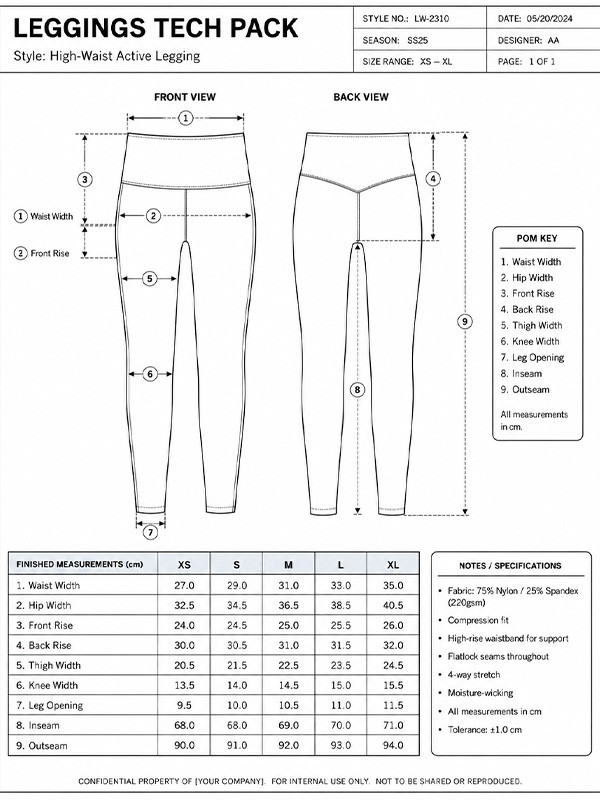
Alt-text: A page from a technical pack for leggings, showing flat sketches with measurement callouts and a detailed size chart.
While creating a tech pack from scratch is complex, many online resources offer templates for common garments like leggings that you can adapt.
Quality Assurance: Testing is Trust Quality control is the process of ensuring that every garment meets your standards, from fabric quality to final packaging. This involves a series of tests and inspections.
The Squat Test: For yoga wear, especially leggings, being "squat-proof" is non-negotiable. This simply means the fabric must remain fully opaque and not become see-through when stretched during a deep squat. There is no official industry standard, but the test is simple: perform a deep squat in front of a mirror in bright, natural light. If you can see skin or underwear, the leggings fail. Reputable brands test this by wearing brightly colored tights underneath the leggings during the test. Key factors for passing the squat test are fabric density (a GSM, or grams per square meter, of 220+ is recommended) and material composition (blends of nylon/polyester with at least 20% spandex perform well).
The Wash Test: This test determines how your garment holds up to home laundering. It assesses several key factors:
- Dimensional Stability (Shrinkage): A fabric sample is measured, washed, and dried according to care instructions, then re-measured to calculate the percentage of shrinkage.
- Colorfastness: This checks if the fabric's dye will bleed or fade. A common on-site test is a "crock test," where the fabric is rubbed with a white cloth to check for color transfer.
- Appearance: After washing, the garment is inspected for any pilling (fuzz balls on the surface), puckering at the seams, or degradation of prints or logos.
Before committing to bulk production, you must request and approve a final "golden sample." This exact sample, built from your tech pack and approved by you, becomes the benchmark against which every single piece in your production run will be measured.
Building My Brand and Online Presence to Start a Yoga Wear Brand
I have successfully gathered information for the "Building My Brand and Online Presence" section. The search results cover brand identity, story, Shopify store setup, visual marketing, and social media engagement.
Here's my plan for writing this section:
H3: Defining My Brand Identity and Story:
- I'll start by explaining what brand identity and voice are, referencing sources like,,, and.
- I will emphasize creating a mission/purpose statement, drawing inspiration from how brands like Lululemon and Alo Yoga define theirs (,, and).
- I'll discuss the importance of a compelling origin story to build an emotional connection, using insights from and.
- I will provide a template or key questions for the user to define their own brand voice, based on and.
H3: Developing My Online Sales Channels and Essential Logistics:
- Shopify: I will walk through the key steps of setting up a Shopify store, as it's the industry standard. I'll cover choosing a theme, creating essential pages, and adding detailed product pages with sizing guides, referencing,, and.
- Shopify Apps: I'll recommend essential app categories for fashion brands based on the search results, such as size recommenders (Kiwi), review/UGC apps (Loox, Yotpo, Foursixty), and email marketing (Klaviyo), drawing from,,, and.
- Logistics: I'll briefly touch on fulfillment options, explaining self-fulfillment vs. a Third-Party Logistics (3PL) provider for when the brand scales, using information from,, and.
H4: Strategic Visual Marketing and Social Media Engagement:
- Visuals: I'll stress the importance of high-quality product photography and choosing authentic models that reflect the target audience, citing,, and.
- Social Media Platforms: I'll recommend focusing on Instagram and TikTok as key visual platforms for yoga wear, based on and.
- Content Strategy: I will provide concrete content ideas: authentic behind-the-scenes content, tutorials (e.g., pose of the day), styling tips, and user-generated content (UGC). I'll reference,, and for these strategies.
- Community Building: I will explain how to build a community, not just an audience, by engaging with followers, using branded hashtags, encouraging UGC, and collaborating with influencers, using insights from,, and.
This structure allows me to logically flow from the abstract (brand identity) to the practical (Shopify setup) and finally to the promotional (marketing and social media), providing a comprehensive guide for this stage of the business. I have enough information to proceed without a new search immediately.
A beautifully designed and manufactured product is only half the battle. Without a strong brand and a place to sell it, even the world's best yoga leggings will remain unknown. This is where you build the soul of your company and the channels through which you connect with your customers. It’s about creating an identity that resonates and an online experience that is seamless and inspiring.
Defining My Brand Identity and Story
In a crowded market, your brand identity is what sets you apart. It's more than just a logo and a color palette; it's the distinct personality and emotion that your business evokes. This identity is communicated through your brand voice, which is the consistent tone and style you use in all your communications, from website copy to Instagram captions.
Before you write a single product description, you must define what your brand stands for. Start by crafting your mission and purpose. Lululemon's purpose is "to elevate the world by realizing the full potential within every one of us." Alo Yoga's mission is "inspiring mindful movement, inspiring wellness and creating community." These aren't just taglines; they are guiding principles that inform every decision.
Crafting Your Brand Story People don't just buy products; they buy stories. Your brand story should articulate who you are and why your business exists. It’s a powerful way to build trust and an emotional connection with your audience.
Answer these questions to unearth your narrative:
- What is your origin story? Share what inspired you to start this journey. Was it your own search for the perfect yoga pants? A desire to create a more inclusive community? Be authentic and personal.
- What are your core values? Identify 3-5 principles that guide your brand. Examples include sustainability, inclusivity, performance, or mindfulness. These values should be reflected in your actions, from fabric choices to marketing campaigns.
- What transformation do you offer? Alo Yoga promises that customers will "feel more confident and comfortable," leading to "a measurable increase in daily activity levels." How will your brand improve your customer's life?
Defining Your Brand Voice Once you have your story, define the voice you'll use to tell it. Is your brand playful and witty, or calm and supportive? Authoritative and expert, or friendly and conversational? Create a simple brand voice chart to keep your communication consistent across all platforms.
| We Are… (Brand Traits) | We Are Not… (Opposite Traits) | Example Phrases |
|---|---|---|
| Empowering & Confident | Preachy or Intimidating | "Own your flow," "Strength from within" |
| Mindful & Calm | Hype-driven or Aggressive | "Find your center," "Breathe into the moment" |
| Authentic & Relatable | Polished to perfection, Unattainable | "Real movements for real bodies," "Styled for your everyday" |
This clear identity will be your north star as you build your online presence.
Developing My Online Sales Channels and Essential Logistics
For a new yoga wear brand, a direct-to-consumer (DTC) model through your own online store is the best way to launch. It gives you complete control over your brand experience, customer relationships, and profit margins.
Setting Up Your Shopify Store Shopify is the industry-standard e-commerce platform for a reason: it's powerful, user-friendly, and scalable. Building a successful store involves more than just uploading products.
Here is a step-by-step guide:
- Sign Up and Choose a Plan: Shopify offers a trial period, giving you time to build your store before committing. The initial plans are affordable and can be upgraded as you grow.
- Get a Custom Domain: Purchase a domain name (e.g., "yourbrandname.com") through Shopify or a provider like GoDaddy. This looks far more professional than the default "yourbrand.myshopify.com" address.
- Select and Customize a Theme: The Shopify Theme Store offers hundreds of free and premium themes. Choose a theme that is clean, visually-driven, and mobile-first. You can customize fonts, colors, and layouts to match your brand identity without any coding knowledge.
- Create Essential Pages: Before you launch, your store needs several key pages:
- About Us: Tell your brand story here.
- Contact Us: Provide clear ways for customers to reach you.
- FAQ (Frequently Asked Questions): Answer common questions about shipping, returns, sizing, and product care.
- Policies: Use Shopify's templates to generate your Return Policy, Privacy Policy, and Terms of Service.
- Build Detailed Product Pages: Your product pages do the heavy lifting of selling. Since customers can't touch or try on the items, these pages must be incredibly detailed. Include:
- High-quality product photos from multiple angles.
- A compelling product description that highlights features and benefits.
- Detailed information on fabric composition and care instructions.
- A comprehensive Sizing Guide. Sizing confusion is a top reason for returns in fashion e-commerce. Provide detailed measurements and, if possible, show the product on models of different sizes.
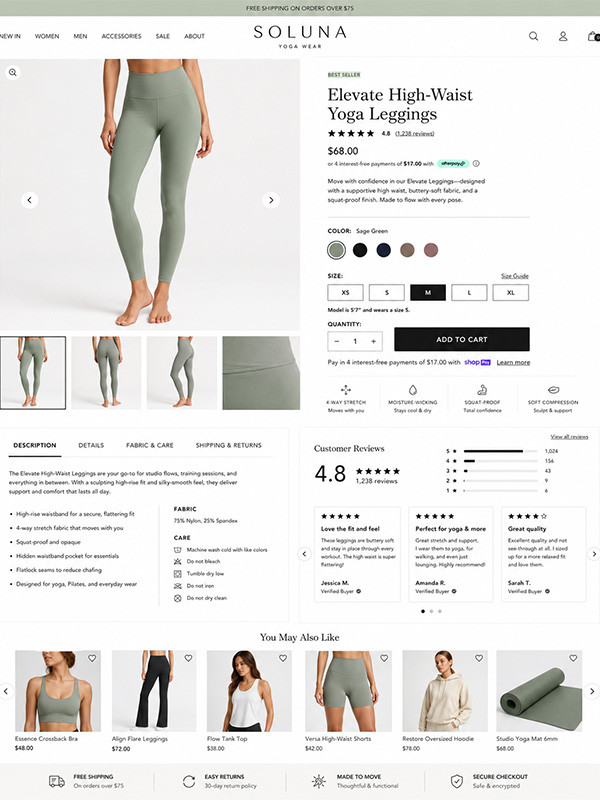
Alt-text: A Shopify product page for yoga leggings, featuring multiple product images, a size selector, a detailed description, and customer reviews.
Essential Shopify Apps for a Yoga Wear Brand The Shopify App Store allows you to add powerful features to your store. For a fashion brand, a few app categories are essential:
- Size Charts & Recommendations: Apps like Kiwi Size Chart & Recommender help reduce returns by allowing you to create custom size guides for each product. Some even use AI to recommend the best fit for a customer.
- Product Reviews & UGC: Social proof is critical. Apps like Loox, Yotpo, or Foursixty automate requests for customer reviews (especially photo reviews) and allow you to showcase them in beautiful galleries on your site. This builds immense trust.
- Email & SMS Marketing: Capturing visitor emails is vital. An app like Klaviyo is the gold standard for fashion brands, enabling you to send automated emails for abandoned carts, welcome new subscribers, and announce product drops.
- Upsell & Cross-Sell: Tools like ReConvert Upsell & Cross Sell or Honeycomb can increase your average order value by suggesting complementary products on the product page, in the cart, or even after checkout.
Logistics and Fulfillment At first, you will likely handle fulfillment yourself (self-fulfillment), packing and shipping orders from your home or office. This gives you complete control over the customer experience, allowing you to add personal touches like handwritten notes.
As your brand grows and order volume increases, managing fulfillment becomes a full-time job. At this point, many brands partner with a Third-Party Logistics (3PL) provider. A 3PL company handles everything for you: warehousing your inventory, picking and packing orders, and shipping them to customers. Companies like ShipHype, ShipMonk, and Bergen Logistics specialize in apparel fulfillment, which is crucial because they understand how to manage multiple SKUs (sizes/colors) and the high return rates common in fashion.
Strategic Visual Marketing and Social Media Engagement
Visuals are everything in the fashion industry. Your marketing should focus on creating a beautiful, inspiring world around your brand.
Authentic Visuals and Models High-quality photography and videography are a non-negotiable investment. Your imagery should not only showcase the product but also sell the lifestyle.
- Show Movement and Function: Your models should be more than just static figures. Hire models with experience in fitness, yoga, or dance who can move naturally and confidently, showcasing the apparel's flexibility and fit during actual poses.
- Embrace Diversity and Authenticity: Your customers want to see themselves reflected in your brand. Feature a diverse range of body types, ethnicities, and ages. Authenticity wins; showcasing real athletes, yoga instructors, or even your own customers can add immense credibility.
Building a Community on Social Media Social media is where you'll find and engage with your target audience. For a visual brand like yoga wear, platforms like Instagram and TikTok are paramount. Your goal isn't just to gather followers; it's to build an invested community.
- Develop a Content Strategy: Plan your content to be valuable, not just promotional. A good mix includes:
- Educational Content: Short Reels or carousels like "Three Poses for Tight Hips" or tutorials on yoga philosophy.
- Inspirational Content: Aesthetically pleasing photos, quotes, and mood-setting videos.
- Behind-the-Scenes: Show your design process, a day at a photoshoot, or packing orders. This humanizes your brand.
- User-Generated Content (UGC): Encourage customers to tag your brand in their photos by creating a unique hashtag (e.g.,
#FlowWith[YourBrand]). Reposting their content is the most powerful form of social proof.
- Engage, Engage, Engage: Social media is a two-way conversation. Respond to every comment and message. Ask questions in your captions to spark discussion. Use interactive features like polls and Q&As in your Instagram Stories.
- Collaborate: Partnering is one of the fastest ways to grow. Collaborate with wellness influencers, other instructors, or local businesses like juice bars for joint giveaways or co-hosted live sessions. Instagram's "Collab" feature allows a single post to appear on both of your profiles, instantly expanding your reach.
By consistently showing up with valuable and authentic content, you transform passive followers into a loyal community that feels emotionally connected to your brand's journey.
Strategic Marketing, Budgeting, and Scaling for My Yoga Clothing Business Guide
I have a good set of search results covering the final section on marketing, budgeting, and scaling. I will now integrate this information into the last part of the blog post.
Plan for Section 4:
- H2: Strategic Marketing, Budgeting, and Scaling: This will be the introductory paragraph for the final major section.
- H3: Generating Hype and Adapting to Trends:
- Hype Generation: I will detail a pre-launch and launch marketing strategy. This will include building an email waitlist, using teaser content on social media, partnering with micro-influencers, and making the launch an "event" with exclusive offers or pre-orders, based on insights from,,,,, and. I will use the term "product drop" to frame the launch.
- Trend Adaptation: I'll explain the importance of staying current. I will discuss short-term and long-term fashion forecasting methods, including analyzing runway shows, using social media listening tools (like Brandwatch), and tracking search engine data, referencing information from,, and.
- H3: Budgeting for Sustainable Growth and Learning from Success:
- Budgeting: I will provide a realistic breakdown of startup costs for a small-batch clothing brand, citing figures from,, and. I'll create a detailed budget table outlining key expense categories like design, manufacturing, marketing, and operations, structured based on templates mentioned in,, and.
- Learning from Success (KPIs & Case Studies): I'll identify crucial Key Performance Indicators (KPIs) for an e-commerce fashion brand to track, such as Conversion Rate, Average Order Value (AOV), and Return Rate, using,,,, and as sources. I'll frame this as the method for measuring success and making data-driven decisions for scaling. I will then weave in a case study example, drawing from the success stories of brands like Alo Yoga and CorePower Yoga (), to illustrate how a brand can professionalize a niche and scale effectively. This will provide a practical, inspiring example to cap off the section.
After completing this section, I will move on to the FAQ and Conclusion, which I can now write based on the comprehensive content I've developed.
Having a great product and a beautiful online store is the starting point, not the finish line. The final, crucial piece of the puzzle is to strategically market your brand to the right people, manage your finances for long-term health, and lay the groundwork for scalable growth. This is where you transform your launch into a sustainable business.
Generating Hype and Adapting to Trends
In the fashion world, buzz is everything. A successful launch isn't something that just happens; it's a carefully orchestrated event designed to build maximum anticipation and demand. You don't just "release" a product; you "drop" it.
Creating Hype for Your Product Drop A successful product drop is a story you tell for weeks or even months before launch day. The goal is to build a group of eager customers who are ready to buy the moment your collection goes live.
Here’s a proven pre-launch marketing plan:
- Build an Email/SMS Waitlist: Your email and SMS list is your most valuable marketing asset because you own it. Before you launch, create a simple "Coming Soon" page on your website that captures email addresses. This list represents your most interested potential customers.
- Execute a Teaser Campaign: Use social media to build suspense. Drip-feed your audience with sneak peeks without revealing everything at once. Post behind-the-scenes content like design sketches, fabric selections, and photoshoot preparations. A countdown in the days leading up to the launch is a simple but powerful way to generate excitement.
- Partner with Micro-Influencers: Before the launch, send your product to a curated list of influencers who genuinely align with your brand's niche and values. Authentic endorsements from trusted voices are incredibly powerful. A post from a micro-influencer showing how they wear your leggings can generate more trust than a traditional ad.
- Make the Launch an Event: Treat your launch day like a party. You can offer an exclusive "early bird" discount to your email list, run a social media giveaway, or bundle products for a special launch-day price. Tactic like showing low inventory levels ("Only 10 left!") can also create a sense of urgency and scarcity, encouraging immediate purchases.
- Enable Pre-Orders: Allowing customers to pre-order is a fantastic way to gauge demand and secure sales before your main inventory even arrives. It also makes your first customers feel invested and part of an exclusive group.
Adapting to Evolving Trends The athleisure market moves fast. What’s popular today might be outdated in six months. Staying relevant requires you to be a student of fashion trends. This is the work of fashion trend forecasting, which involves analyzing data and cultural signals to predict what's next.
- Short-Term Forecasting (The Next 1-2 Years): This is about predicting specific styles, colors, and fabrics. To do this, you should:
- Monitor Runways and Street Style: Keep an eye on major fashion weeks and what tastemakers are wearing in fashion capitals.
- Use Social Listening Tools: Platforms like Brandwatch and Sprout Social can track keywords and hashtags (e.g., "flared leggings," "yoga onesie") across Instagram and TikTok to see which styles are gaining traction in real-time.
- Analyze Search and Sales Data: Tools like Google Trends can show you what consumers are actively searching for, providing direct insight into demand.
- Long-Term Forecasting (5+ Years): This is about understanding macro-level shifts in consumer values, such as the growing demand for sustainability or the move towards gender-neutral apparel. Staying on top of these big-picture changes will inform your brand's overall direction and strategy.
By combining these forecasting methods, you can make informed decisions about your next collection, ensuring your brand feels fresh and relevant season after season.
Budgeting for Sustainable Growth and Learning from Success
A great idea without a sound financial plan is a hobby, not a business. Budgeting isn't the most glamorous part of starting a brand, but it is the most critical for survival and growth.
Budgeting for Your Yoga Wear Brand How much does it really cost to start a clothing brand? The honest answer is that it varies widely based on your model, but a legitimate small-batch brand with custom manufacturing requires a real investment. A realistic budget for a bootstrapped but professional launch often falls between $15,000 and $30,000.
Here is a sample budget breakdown for a small, manufactured launch to illustrate where that money goes:
| Expense Category | Estimated Cost | Percentage of Budget | Key Line Items |
|---|---|---|---|
| 1. Design & Development | $2,000 - $5,000 | 10-15% | Tech packs, pattern making, multiple rounds of sample development. |
| 2. Production & Inventory | $8,000 - $15,000 | 40-50% | Fabric sourcing, manufacturing of first production run (e.g., 3-5 styles, 100-200 units each), labels, hang tags, and packaging. |
| 3. Branding & Website | $2,500 - $6,000 | 15-20% | Brand identity/logo design, website setup (Shopify theme and apps), product photography and videography. |
| 4. Marketing & Launch | $2,000 - $5,000 | 10-15% | Initial ad spend (social media), influencer seeding, launch-day promotions. |
| 5. Operations & Contingency | $1,500 - $4,000 | 10% | Business registration/legal fees, software subscriptions, shipping supplies, and a buffer for unexpected costs. |
| Total Estimated Budget | $16,000 - $35,000 | 100% |
This budget demonstrates that marketing and inventory are the largest ongoing expenses. The biggest mistake new founders make is underestimating these costs and running out of capital just as they are starting to gain momentum.
Learning from Success: KPIs and Scaling Once you've launched, how do you measure success and make smart decisions to grow? You need to track your Key Performance Indicators (KPIs). For a DTC fashion brand, the most important metrics are:
- Conversion Rate: The percentage of website visitors who make a purchase. A typical e-commerce conversion rate is around 2%.
- Average Order Value (AOV): The average amount customers spend in a single transaction. You can increase this through bundling products or offering upsells.
- Customer Acquisition Cost (CAC): How much it costs in marketing spend to acquire a new customer.
- Customer Lifetime Value (CLV): The total revenue you expect to generate from a single customer over their lifetime. A successful brand has a CLV that is significantly higher than its CAC.
- Return Rate: The percentage of orders that are returned. For online apparel, this can be as high as 15-25%, so monitoring and reducing this is crucial for profitability.
Tracking these KPIs will tell you what's working and what isn't, allowing you to invest more in successful strategies and cut what's failing.
Case Study in Success: The Professionalized Niche Consider the journey of brands like CorePower Yoga. They didn't invent yoga, but they were among the first to professionalize a niche practice for a mass-market audience. They succeeded by creating a consistent, high-quality, and results-oriented experience that appealed to fitness consumers, not just traditional yogis. This strategy dramatically widened their customer base and built immense brand trust. Similarly, a small brand like 3 Bridges Yoga saw 75% growth in its first year by boldly investing in marketing and creating a clear positioning line—"Yoga For Every Body"—to attract beginners, setting them apart in a crowded local market.
The lesson here is to not just create a product, but to build a system. By understanding your niche deeply, creating a predictable and high-quality product, marketing it strategically, and making data-driven decisions, you can scale your passion project into a powerful and profitable brand. Your journey from 0 to 2,000+ pieces sold per month begins with these foundational steps.
Frequently Asked Questions (FAQ)
1. How much does it realistically cost to start a yoga wear brand in 2026? The cost varies significantly based on your business model. A print-on-demand (POD) brand can be launched for as little as $1,000–$5,000, which covers branding, website setup, and initial marketing. However, to create a brand with custom-manufactured products, a more realistic budget is between $15,000 and $30,000 for a small-batch launch. This covers professional design and development (tech packs, samples), a small production run (100-200 units per style), branding, a quality e-commerce site, and a marketing budget to actually acquire customers.
2. Do I need to be a fashion designer to start a yoga wear brand? No, you don't need to be a designer, but you do need a clear vision. Many successful brand founders are not designers themselves. They act as the creative director, defining the brand's aesthetic, target customer, and values. They then hire freelance fashion designers or work with a full-package production (FPP) manufacturer that offers design services. Your role is to guide the creative process and ensure the final products align with your brand identity.
3. What is the most important first step in starting a yoga apparel line? The most critical first step is market research and niche identification. Before you spend a dollar on design or manufacturing, you must understand the market landscape, analyze your competitors, and define a specific, underserved niche for your brand. Trying to appeal to everyone is a recipe for failure. A well-defined niche—whether it's sustainable materials, plus-size fits, high-performance wear for a specific type of yoga, or a unique aesthetic—will inform every other decision and make your marketing efforts far more effective and less expensive.
4. How do I find a reliable manufacturer for my clothing? Finding a reliable manufacturer is crucial and requires diligent research. Key methods include:
- Online Sourcing Platforms: Directories like a Maker's Row list vetted, often domestic, manufacturers.
- Trade Shows: Attending industry events allows you to meet suppliers face-to-face and inspect their quality.
- Referrals: Network with other fashion entrepreneurs. A personal recommendation is often the most trustworthy source. Once you have a shortlist, vet them by asking about their Minimum Order Quantities (MOQs), lead times, and experience in activewear. Always request samples to evaluate their quality before committing to a full production run.
5. What makes a pair of yoga leggings "high quality"? High-quality yoga leggings are defined by three key elements:
- Fabric: The best leggings use a technical blend of materials, typically Nylon and Spandex/Lycra (e.g., an 80/20 blend). This combination offers a "buttery-soft" feel, 4-way stretch for unrestricted movement, and excellent moisture-wicking properties. Fabric density, measured in GSM (grams per square meter), should ideally be 220+ to ensure it's not see-through.
- Construction: Look for strong, comfortable seams like flatlock stitching, which minimizes chafing. A well-constructed gusset (a diamond-shaped piece of fabric in the crotch) allows for greater range of motion and durability.
- Performance: The leggings must be "squat-proof"—meaning fully opaque even when stretched. They should also hold their shape after repeated wear and washing without pilling or sagging.
6. What are the most important marketing channels for a new yoga wear brand? For a visual product like yoga wear, the most effective marketing channels are Instagram, TikTok, and Email Marketing.
- Instagram & TikTok: These platforms are perfect for visual storytelling. Use high-quality photos and short-form video (Reels) to showcase your product in motion, share behind-the-scenes content, and build a community.
- Email Marketing: Your email list is your most powerful tool for driving sales. Use it to announce product drops, offer exclusive discounts to subscribers, and build a long-term relationship with your customers away from the noise of social media algorithms.
Conclusion
Starting your own yoga wear brand is an exciting and deeply rewarding venture in a market that continues to thrive on the global embrace of wellness and active living. By following this comprehensive guide—from conducting in-depth market research and defining your unique niche to meticulously designing your collection and executing a strategic launch—you are equipped with the blueprint for success. This journey requires dedication, creativity, and careful planning, but the opportunity to build a meaningful brand that resonates with a passionate community is immense.
I am ready to transform my passion into a profitable business, making my mark in the activewear world with thoughtful planning and execution, guided by this yoga clothing business guide. Now it's your turn to take these steps, infuse them with your unique vision, and bring your brand to life. This is more than just starting a business; it's about creating apparel that empowers movement, inspires confidence, and becomes a beloved part of your customers' wellness journey. You have the guide, you have the vision—go make it happen.