Top 10 Criteria for Choosing a Reliable Half-Zip Pullover Manufacturer
- Share
- Issue Time
- May 18,2026
Summary
Stop dealing with wavy zippers and choking collars. This 10-point technical guide helps athleisure brands audit half-zip pullover manufacturers. Learn the factory standards for fixing zipper buckling, balancing heavy collars, preventing fleece shedding, and managing vertical shrinkage to build structured, functional quarter-zip fleece sweatshirts.

The half-zip (or quarter-zip) pullover has become the staple outerwear piece for modern athleisure brands. Consumers want the thick, cozy feel of heavyweight fleece combined with the structured, sharp look of a stand collar and metal hardware.
However, mixing knit fabrics with heavy hardware requires precision tailoring. At Call The Style, we rely on physics and strict sewing protocols to build pullovers that hold their shape. Ask your potential supplier these 10 practical questions to verify their technical capability before placing an order.
1. Front Zipper Buckling: The Chest Ripple
The Common Problem: Wavy Zippers
The most frequent defect on a half-zip is a zipper that ripples and bulges outward on the chest. This happens because the sewing machine feed dogs stretch the soft fleece fabric while attaching the non-stretch zipper tape. When the fabric relaxes, it bunches up around the rigid zipper.
The Factory Solution: Fusible Edge Stabilization
We fix this in the preparation stage. Our operators iron a narrow strip of non-stretch Fusible Interfacing Tape along the raw edges of the center-front slit before the zipper is attached. This temporarily kills the stretch in the seam allowance, allowing the fabric and zipper to lay dead-flat when sewn together.
2. Collar Drag: The Choking Effect
The Common Problem: The Shirt Pulls Backward
Many half-zips feature a double-layered heavy fleece collar and a chunky metal zipper. If standard t-shirt pattern grading is used, the sheer weight of this collar will pull the entire garment backward over the shoulders, causing the front neckline to choke the wearer.
The Factory Solution: Weight-Balanced Pattern Drafting
We shift the center of gravity. Our pattern makers execute a Forward-Rolled Shoulder Seam, moving the shoulder line 1 to 2 inches toward the front chest. We also add more volume to the back panel. This creates a mechanical counterbalance, ensuring the heavy collar rests squarely on the collarbone without dragging backward.
3. The Neck Seam Lump
The Common Problem: A Hard Knot at the Throat
At the center-front of the neck, the collar, the body fabric, and the zipper tape all intersect. In cheap production, sewing these heavy layers together creates a massive, hard lump of fabric that painfully presses into the wearer's throat.
The Factory Solution: Seam Grading and Twill Tape
We reduce the profile. Workers manually trim the internal seam allowances to different staggered lengths (seam grading) so they don't stack on top of each other. We then cover this junction with a flat Woven Twill Tape Binding, pressing it down to ensure a smooth, irritation-free finish against the skin.
4. Post-Wash Zipper Rippling (Shrinkage Mismatch)
The Common Problem: Wavy Zippers After Laundry
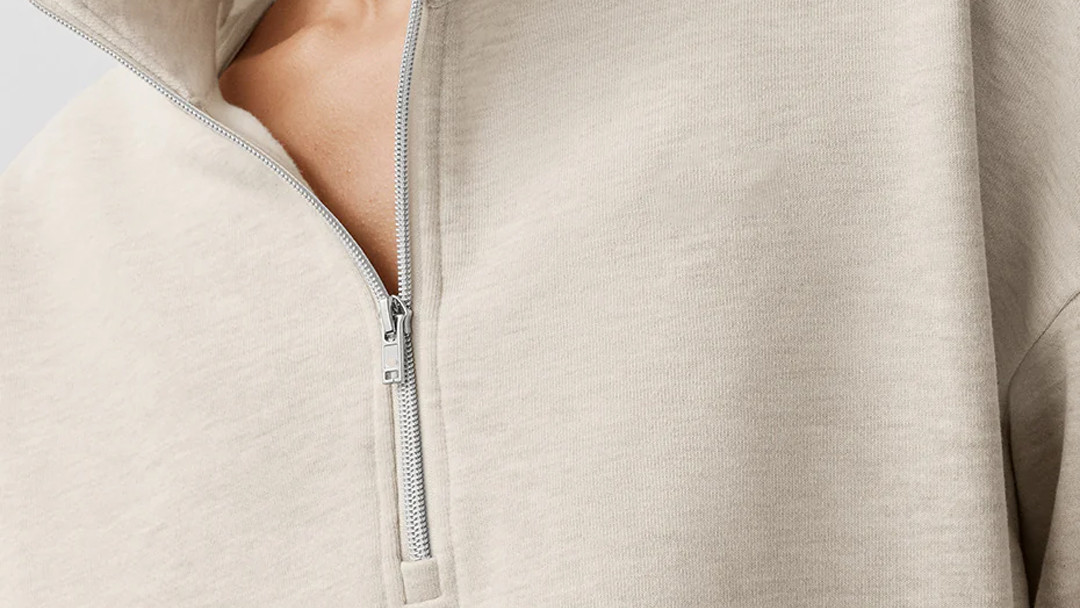
Sometimes a half-zip looks flat in the store, but after one wash and dry, the zipper suddenly ripples violently. This is a basic physics failure: the 100% cotton fleece body shrunk vertically by 5% in the heat, but the plastic/metal zipper did not shrink at all.
The Factory Solution: Pre-Shrunk Milling and Tolerance
We calculate shrinkage limits before cutting. We utilize pre-shrunk tumbling processes at the fabric mill to ensure the fleece has a vertical shrinkage rate of less than 3%. We also wash-test the zipper tape to ensure its dimensional stability matches the fabric, preventing post-wash deformation. (Avoid material errors with our Tech Pack Mistake Guide.)
5. Hardware Weight Ratios
The Common Problem: Heavy Zippers Tearing Soft Fabric
Brands often request chunky #5 or #8 metal zippers for a rugged look. However, if this heavy metal is sewn onto a soft, lightweight French terry, the weight of the teeth will drag the chest down and eventually tear the knit fabric at the base of the zipper.
The Factory Solution: Injected Plastic (Vislon) or Nylon Coil
We balance the hardware. For lighter or highly stretchable knits, we strongly advise using #5 Injected Plastic (Vislon) zippers or Nylon Coil. They offer the chunky aesthetic without the destructive weight of solid brass or zinc.
6. Managing Fleece Shedding
The Common Problem: Fuzz on the T-Shirt
The interior of a winter pullover is mechanically brushed to create a soft fleece texture. If the factory skips finishing steps, this interior will constantly shed, leaving clumps of fuzz all over the wearer's base layer.
The Factory Solution: Vacuum Shearing
We mandate a strict finishing process at the mill. After brushing, the fabric undergoes Shearing and Vacuuming. This physically trims uneven loose fibers and vacuums the excess lint away before the fabric is ever cut. (See our QC protocols in our Quality Control Breakdown.)
7. The Zipper Garage (Chin Guard)
When the pullover is zipped all the way up against the cold, a raw metal slider will scratch the wearer's chin. We construct a Fold-Over Fabric Garage at the very top of the collar. When fully zipped, the slider parks securely underneath this fabric flap, keeping the hardware completely away from sensitive skin.

8. Hem Cinching: Preventing Hardware Tear-Outs
Many modern pullovers feature an elastic bungee cord and toggle at the bottom hem for a cropped, cinched look. If the metal eyelet for this cord is punched directly into raw fleece, it will tear out when the cord is pulled tight. We apply rigid Fusible Interfacing to the inside of the hem before punching the eyelet, giving the metal hardware a solid anchor point. (Read more about construction in our Yoga Pants Guide.)
9. Pocket Placement and Sag
If kangaroo pockets or side seam pockets are constructed from the exact same 400 GSM heavy fleece as the body, they create massive bulk at the stomach and drag the front of the shirt down. We construct internal pocket bags out of lightweight, durable 160 GSM jersey cotton to reduce bulk, and anchor the top of the pocket bags into the side seams to prevent sagging.
10. Armhole Mobility in Heavy Knits
Thick fleece does not stretch easily. If a factory uses a tight, standard armhole pattern, the wearer will not be able to lift their arms comfortably. We adjust the block pattern by dropping the shoulder seam slightly and widening the armscye (armhole curve), ensuring full athletic mobility without making the torso look overly baggy. (See how pattern adjustments save money in our Cost Analysis Guide.)
Manufacture Pullovers That Keep Their Shape
Stop dealing with wavy zippers, choking collars, and shedding fleece. Partner with Call The Style for structurally sound, heavyweight athleisure outerwear.
START YOUR PROJECTFrequently Asked Questions (FAQ)
Q: Why does the front zipper on my half-zip pullover look wavy?
A: The machine stretches the elastic fabric while attaching the non-stretch zipper. We fix this by ironing fusible interfacing tape along the fabric edge before sewing to temporarily kill the stretch and keep the seam flat.
Q: Why does my pullover pull backward and choke me at the neck?
A: A heavy collar and zipper throw off the center of gravity. We adjust the pattern by shifting the shoulder seams forward and adding volume to the back, counterbalancing the weight so it sits correctly on the chest.
Q: Why did the zipper become wavy only after I washed the pullover?
A: This is a shrinkage mismatch. The cotton fleece shrunk vertically in the dryer, but the plastic zipper did not. We use pre-shrunk fabrics with under 3% shrinkage tolerances to prevent post-wash buckling.
Q: How do you stop the inside of a fleece pullover from shedding fuzz?
A: Shedding is caused by loose brushed fibers. We require the fabric mill to run the fleece through a strict shearing and vacuuming process to trim and remove loose lint before cutting.